Who Makes the Best Kitchen Cabinets in Ghana?
By 44 Wood | Custom Kitchen Cabinets & Fitted Kitchens in Accra, Ghana
Choosing who builds your kitchen is one of the most consequential decisions you will make in your home. Not just because the kitchen is expensive, although it is but because you will interact with the result every single day for the next 10 to 20 years. A good decision means a kitchen that works beautifully and stays that way. A bad one means visible deterioration within two or three years and the prospect of doing it all again.
The challenge in Ghana is that the kitchen cabinet market has no easy quality filter. There are carpenters, cabinet makers, importers, franchise operations, online sellers, market traders, showroom companies, and everything in between all describing themselves in similar language, all showing project photos that may or may not represent their standard work. A homeowner without insider knowledge has very little to go on.
At 44 Wood, we have been installing kitchen cabinets in Ghana for over a decade. We know the questions that separate a company worth commissioning from one that will let you down. We are sharing them here, because an informed client makes better decisions and ultimately, everyone benefits from a market where quality is properly understood.
The Ghanaian Kitchen Cabinet Market: Understanding What You Are Choosing Between
Before getting into how to evaluate suppliers, it helps to understand what the market actually looks like.
The Accra Timber Market and Local Carpenters
The Accra Timber Market and surrounding areas are where many Ghanaian homeowners go first for kitchen cabinets. The appeal is clear: proximity, apparent affordability, and the ability to talk directly to someone who will build what you describe.
The reality is more complicated. Most carpenters working in and around timber markets are skilled woodworkers, but they are not kitchen cabinet manufacturers. There is an important distinction. A cabinet maker working in a professional manufacturing environment has precision cutting equipment, edge banding machines, calibrated installation tools, and a system for quality control. A carpenter working with hand tools and a circular saw produces a different quality of output regardless of how skilled they are as woodworkers.
Boards purchased at the timber market are also almost always low-grade local particleboard or imported Chinese board, not the European-grade moisture-resistant MFC used by serious manufacturers. The price difference is visible upfront. The quality difference becomes visible within two years.
China Mall and Ready-Made Imports
China Mall kitchen cabinets and similar imported ready-made options represent a different tier. These are pre-manufactured units produced in volume in China, imported and sold as assembled or flat-pack installations.
They are faster to install and cheaper upfront than custom installations. They are not designed for Ghana’s climate, they come in standardised sizes that rarely fit a specific kitchen well, and the materials are produced to a price point rather than a performance standard. The edge banding on cheap imported cabinets is typically thin and adhesively bonded rather than heat-bonded, and it begins lifting in humid conditions within months.
For a rental property or a very short-term solution, imported ready-made cabinets serve a purpose. For a home you plan to live in for years, the maths does not work in their favour.
Established Local Manufacturers
This is the tier where serious kitchen cabinet companies in Ghana operate. Companies with their own workshop facilities, trained production teams, professional design capability, and an installation operation that is separate from and accountable to the design and manufacturing process.
Within this tier, quality still varies significantly based on the materials sourced, the equipment used, and the installation standards maintained. This is why the evaluation questions below matter even when you are talking to established companies.
What About Loncha Kitchen and Genesis Kitchen Ghana?
These are names that appear in the searches Ghanaian homeowners make when looking for kitchen cabinets in Ghana, and they represent part of the competitive landscape in the Ghanaian kitchen market.
The relevant question for any homeowner is not which company has the most visible brand, but which company will build a kitchen that performs well in your specific home, from materials that handle Ghana’s climate, at a price that reflects genuine value for what is delivered.
The questions that follow in this guide give you a framework to evaluate any kitchen company including 44 Wood on what actually determines outcome quality.
10 Questions to Ask Any Kitchen Cabinet Company in Ghana Before You Sign Anything
1. What board do you use, and where does it come from?
This is the single most important question. The board used in your kitchen cabinets determines how long they last, how well they handle moisture and heat, and how the finish holds up over years of use.
The answer you want: a specific grade and source. European-grade high-density MFC, sourced from Italy, Turkey, or Germany, with a moisture-resistant core. Board density should be at least 680kg per cubic metre for quality MFC.
The answer that should concern you: vague language about “quality boards” or “imported materials” without specifics. Any company that cannot tell you the exact specification of the board they use either does not know or does not want you to know.
At 44 Wood, our boards are sourced from Italy and Turkey. We can tell you the specification, the density, and the moisture-resistance rating because we know exactly what we use and why we use it.
2. What happens to the edges of the cabinet panels?
Edge banding – the finishing strip applied to all cut edges of cabinet boards is one of the most telling quality indicators in any kitchen. Poor edge banding lifts, particularly in humid environments near the sink and cooker. Once it lifts, moisture enters the board core and deterioration begins.
The answer you want: heat-bonded edge banding applied by machine on all exposed edges and all internal edges within the cabinet. The banding should be flush and invisible when done correctly.
The answer that should concern you: hand-applied edge banding, thin banding (less than 1mm), or any indication that internal cabinet edges are left unfinished.
3. What hardware do you use, and what brand?
Kitchen hardware; hinges, drawer runners, push-to-open mechanisms is used dozens of times every day. Over a ten-year kitchen lifespan, a drawer might be opened and closed 10,000 times. Hardware that is not engineered for this load fails long before the cabinets themselves do.
The answer you want: named European hardware brands. German and Italian manufacturers like Blum, Hettich, Grass, and Salice produce hardware that is tested to tens of thousands of cycles. Soft-close mechanisms, full-extension drawer runners, and adjustable hinges from these brands represent the standard you should expect in any quality kitchen installation.
The answer that should concern you: unbranded hardware, Asian-manufactured alternatives described only as “soft close,” or any reluctance to specify where the hardware comes from.
4. Do you design, manufacture, and install or do you subcontract any of these?
This question matters more than most people realise. A company that designs, manufactures, and installs all under the same roof has control over the outcome at every stage. A company that designs in a showroom, sends measurements to a third-party workshop, and uses a separate installation team has three points at which the quality chain can break.
The answer you want: a company that handles all three stages with its own team and in its own facilities.
The answer that should concern you: a company that is primarily a showroom or design operation that outsources the making and fitting to independent contractors. In Ghana particularly, this arrangement regularly produces results that are significantly below the showroom samples.
At 44 Wood, we design, manufacture, and install every kitchen we build. Our workshop is ours. Our installation teams are trained by us and work under our direct supervision.
5. Can I see a completed project, not just showroom samples?
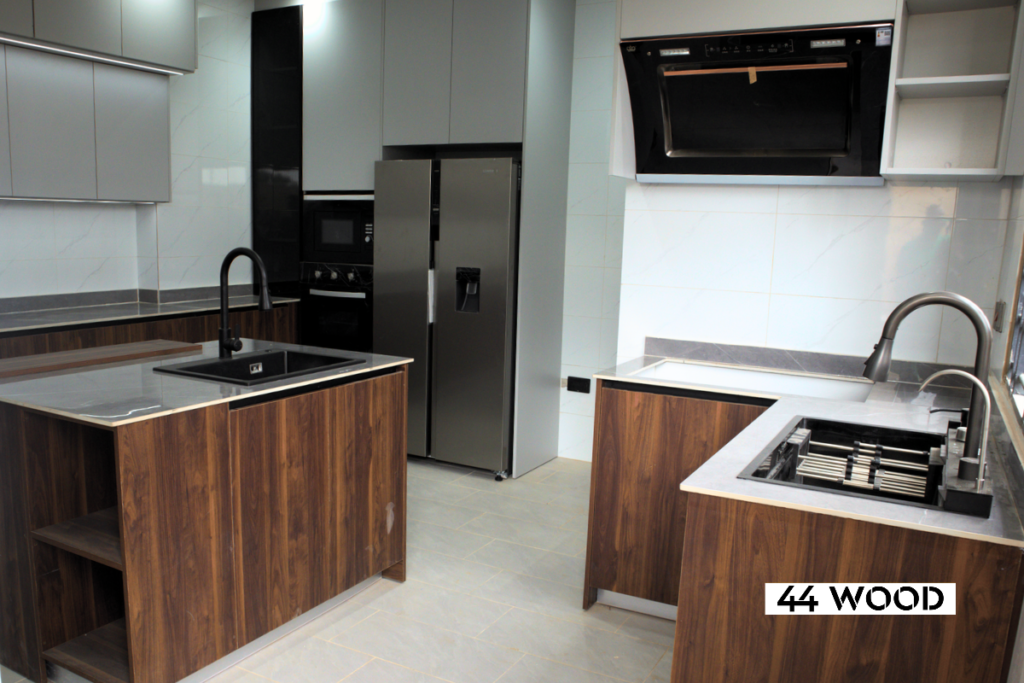
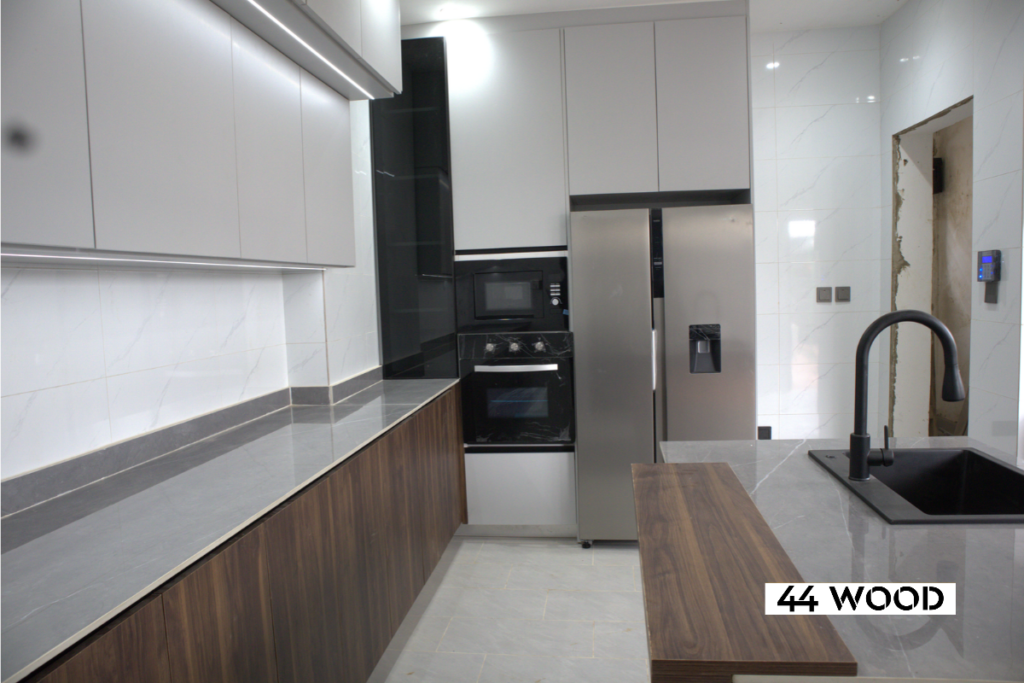
Showroom displays are produced under ideal conditions with premium materials specifically chosen for display. What you need to see is what the company actually delivers into a real home including how the cabinets fit the space, how the doors hang, and how the finish looks after several months of use.
The answer you want: a company that readily offers to show you completed projects, either in person (with client permission) or through a comprehensive, verified portfolio with specific project details.
The answer that should concern you: a company whose portfolio consists entirely of rendered images or international stock photos, or who cannot reference specific completed projects in Ghana.
6. What is included in the price, and what is not?
Kitchen quotes in Ghana vary not just in price but in what is included in that price. Two quotes that look similar may include completely different scopes of work.
Ask specifically: does the price include countertops, sink, tap, and installation of appliances? Does it include the extractor hood housing? Does it include delivery and full installation, or just the supply of cabinets? Are plumbing and electrical connections coordinated within the scope?
A complete fitted kitchen price from 44 Wood includes design, manufacturing, delivery, full installation, and a one-year guarantee. Some competitors quote cabinet supply only, leaving significant additional costs to be discovered later.
7. What is your guarantee, and what exactly does it cover?
Any serious kitchen furniture manufacturer in Ghana should offer a written guarantee on their work. The question is not whether they offer one but what it actually covers and for how long.
The answer you want: a minimum one-year guarantee covering manufacturing defects, hardware failure, and installation quality. Written, not verbal.
The answer that should concern you: verbal assurances without documentation, very short guarantee periods (less than six months), or guarantees that exclude the hardware or the installation.
8. How long will the installation take, from order to completed kitchen?
This matters for project planning and also as a quality indicator. A company that promises installation in two weeks from order is either not building custom cabinets (they are assembling pre-made units) or they are cutting corners in the manufacturing process.
The answer you want: a realistic timeline that reflects genuine custom manufacturing. At 44 Wood, our typical timeline from approved design to completed installation is six to ten weeks, with most of that time in manufacturing.
The answer that should concern you: unrealistically short timelines that cannot accommodate proper manufacturing, or a company that cannot give you a specific timeline at all.
9. How do you handle problems after installation?
This question reveals a company’s character more than almost any other. Problems in a kitchen installation, a drawer that sticks, a door that needs adjustment, a hinge that requires recalibration are not always avoidable. What matters is how quickly and willingly they are resolved.
The answer you want: a clear process. A named point of contact for post-installation issues. A commitment to respond within a specific timeframe. A track record of returning to resolve issues promptly.
The answer that should concern you: vagueness, defensiveness, or any suggestion that post-installation support requires negotiation.
10. Can you provide references from previous clients?
A company that has been building kitchen cabinets in Ghana for years and doing it well has clients who will say so. References are not common practice in the Ghanaian furniture market but they should be, and any company confident in their work should be willing to provide them.
The answer you want: willingness to provide contact details for previous clients who you can call directly.
The answer that should concern you: a company that offers to show you testimonials they have curated themselves but cannot provide direct client references.
Red Flags: Signs That Should Make You Walk Away
Beyond the questions above, here are the specific warning signs that consistently precede a bad kitchen installation experience in Ghana:
A quote significantly below every other quote you have received. In kitchen cabinets, the price reflects the material and labour cost. A quote that is 40 or 50 percent below comparable suppliers is not a bargain; it is a signal that something in the specification has been compromised. The board grade, the hardware, the installation time, or all three.
Pressure to decide immediately. Any supplier applying urgent pressure a discount that expires today, limited stock, special availability, is using sales tactics that have nothing to do with the quality of what they build. Good kitchen companies have enough work that they do not need to pressure individual clients.
No site visit before quoting. A kitchen quote produced without measuring your actual kitchen is either a very rough estimate or based on assumptions that will not hold. Any serious company visits your site before producing a price.
Payment in full upfront. A reasonable payment structure for custom kitchen work is a deposit (typically 50 to 60 percent) at order placement, with the balance due on or after installation. A company that requires 100 percent payment before work begins removes their incentive to deliver promptly and correctly.
No written contract or specification document. Everything agreed should be in writing: the materials, the dimensions, the finish, the hardware, the timeline, the payment terms, and the guarantee. Verbal agreements in kitchen projects regularly end in disappointment.
They cannot tell you specifically what board they use. As discussed above, this is the most fundamental quality indicator. If they cannot answer this question specifically, they are not a company whose kitchen you want in your home.
What a Good Kitchen Company Actually Does
For context, here is the process a professional kitchen furniture manufacturer should follow from first contact to completed installation:
Site visit and measurement. A proper site visit by a designer, not a salesperson. Full dimensional survey of the kitchen space, noting all obstacles, service positions, and workflow considerations. This visit should also be a design consultation — understanding how you cook, what you store, and what you want the kitchen to look like.
Detailed design drawing. A dimensioned drawing showing every cabinet position, interior configuration, door layout, and material specification. You should be able to see exactly what you are getting before anything is built. Revisions should be part of the process, not a paid extra.
Transparent specification and quote. A written document specifying every element: board grade and source, door material and finish, hardware brand and grade, countertop specification, and what is included and excluded in the installation scope.
Manufacturing. Cabinet carcasses cut and assembled, edges finished, door fronts produced, hardware fitted. In a properly run workshop with quality equipment, this takes four to six weeks for a standard kitchen.
Professional installation. Level setting, carcass installation, countertop templating and fitting, door and drawer calibration, hardware adjustment, and the final detail work that distinguishes a finished kitchen from one that is merely assembled.
Post-installation support. A follow-up visit within two to four weeks of installation to address any settling adjustments, answer questions about care, and confirm the client is satisfied.
Why 44 Wood
We are sharing this guide because we believe the Ghanaian kitchen market works better when homeowners are well-informed. Clients who understand what quality looks like make better decisions and they tend to end up working with companies like ours.
44 Wood is one of the leading custom kitchen manufacturers in Ghana. We design, manufacture, and install every kitchen we build. Our boards are sourced from Italy and Turkey. Our hardware is from European manufacturers. Our installation teams are trained and supervised internally. Every kitchen is backed by a one-year written guarantee. At 44 Wood, every project starts with proper site measurements, thoughtful design, quality craftsmanship, and professional installation ensuring your cabinetry is built specifically for your home.
If you’re ready to experience modern kitchen furniture design, crafted with precision, style, and collaboration at its core, 44 Wood is ready to design with you, for you. Why settle for generic when your bedroom can reflect your style, personality, and space perfectly? If you’re dreaming of a kitchen space that’s functional, elegant, and uniquely yours, it’s time to talk to 44 Wood.
let 44 Wood bring your vision to life with a custom space that fits your space, preference and your lifestyle. Discover more: https://www.44wood.com, Message 44 Wood on WhatsApp. https://wa.me/message/7HF3H2PGFS4GP1, Visit our showroom at Spintex, Accra or call 059 222 1787 to get started
A kitchen that lasts begins with choosing the right company to build it. Ask the right questions and the answer becomes clear.
44 Wood | Custom Kitchen Cabinets · Fitted Kitchens · Walk-In Closets · TV Units · Wardrobes · Cladding · Pharmacy Shelving One of the leading furniture manufacturers in Accra and across Ghana, designing and installing bespoke kitchens and interiors for over a decade.