Kitchen Cabinets in Ghana: Every Question Answered
By 44 Wood | Custom Kitchen Cabinets, Fitted Kitchens & Kitchen Furniture in Accra, Ghana
Whether you are building your first home, renovating a kitchen you have lived with for too long, or simply trying to understand what you are getting into before you call anyone, this guide answers every real question about kitchen cabinets in Ghana. Prices, materials, colours, styles, timelines, mistakes to avoid, and how to know whether you are getting value for your money.
At 44 Wood, we are one of the leading kitchen cupboard manufacturers and custom kitchen cabinet installers in Ghana. We have been designing and installing kitchen cabinets in Ghana for over a decade. Everything in this guide comes from that experience.
How Much Do Custom Kitchen Cabinets Usually Cost?
This is always the first question. And it deserves a direct answer.
Custom kitchen cabinets are priced by the project, not by a catalogue price list, because the variables that drive cost are different for every kitchen. Size, layout complexity, material0 grade, door style, interior hardware, countertop specification, and the number of special features (islands, integrated appliances, pantry towers) all determine where a project lands.
That said, here are realistic ranges for kitchen cabinet prices in Ghana in 2026:
A compact kitchen for a two or three bedroom apartment, built in premium MFC with quality hardware and standard features, typically falls within our entry-level investment tier for 44 Wood specifications.
A medium family kitchen in an L or U-shape with standard features and good materials falls into our mid-range investment category.
A large, fully specified kitchen with a kitchen island, pantry tower, integrated appliances, granite countertops, and premium finishes typically represents a premium, high-end investment depending on scale.
The most important thing to understand about kitchen furniture price value in Ghana is that the initial quote and the long-term value you receive are not always the same thing. A kitchen built using low-grade board, cheap hinges, and basic installation will cost you more over five years than a kitchen built properly with premium components. The materials and the hardware inside the cabinets are what determine longevity.
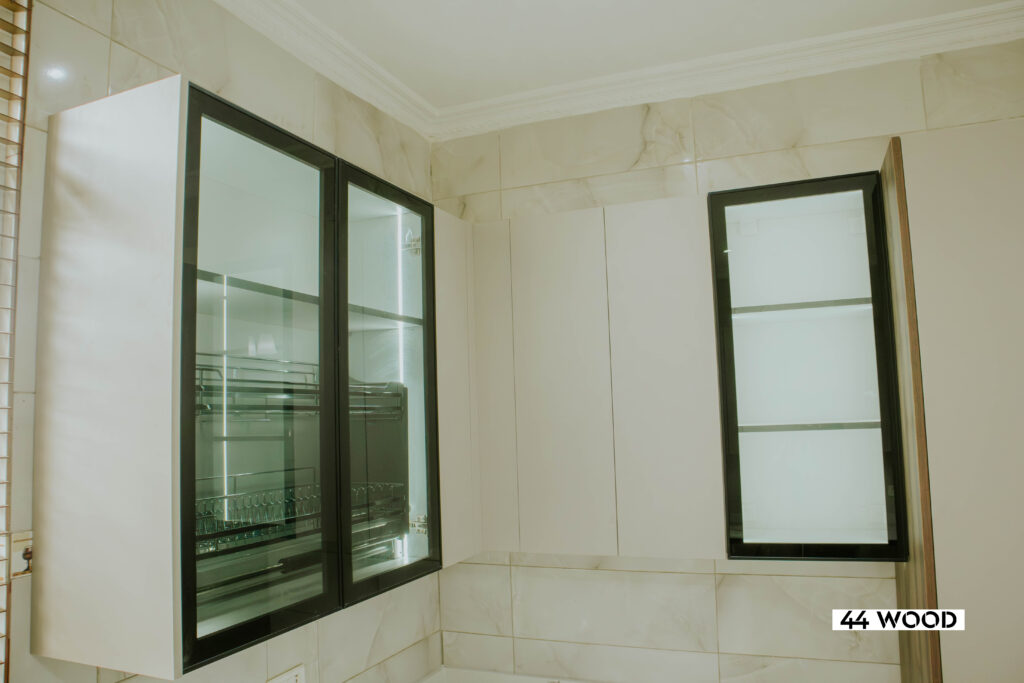
How Much Are Kitchen Cabinets in Ghana?
For ready-made or basic locally assembled kitchen cabinets, prices in the Ghanaian market start from as low as GHS 5,000 to GHS 15,000 for small kitchens using low-grade materials. These are available from timber markets, China Mall, and basic carpenters
The gap between these two numbers reflects the difference in board density, finish quality, hardware grade, installation precision, and how long the kitchen will last before it begins to deteriorate.
44 Wood sits in the professional manufacturing tier. Our kitchen furniture prices reflect premium European-grade materials sourced from Italy and Turkey, trained installation teams, and a one-year guarantee on every project.
What Are the Trendy Styles for Kitchen Cabinets in 2026?
Based on what we are designing and installing across Accra right now, here are the kitchen cabinet styles that are clearly dominant in 2026:
Handleless and push-to-open cabinets are the single most requested design direction. A completely smooth, hardware-free cabinet face gives the kitchen a seamless, contemporary look that ages very well.
Flat panel slab doors remain the dominant door style. Clean, simple, and endlessly versatile across any colour direction.
Two-tone combinations have moved firmly into the mainstream. Wood grain lowers with painted uppers, or dark base cabinets with lighter wall units, add sophistication without requiring any additional design effort.
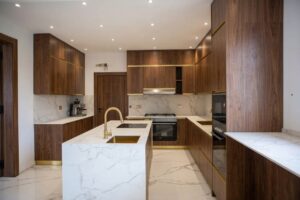
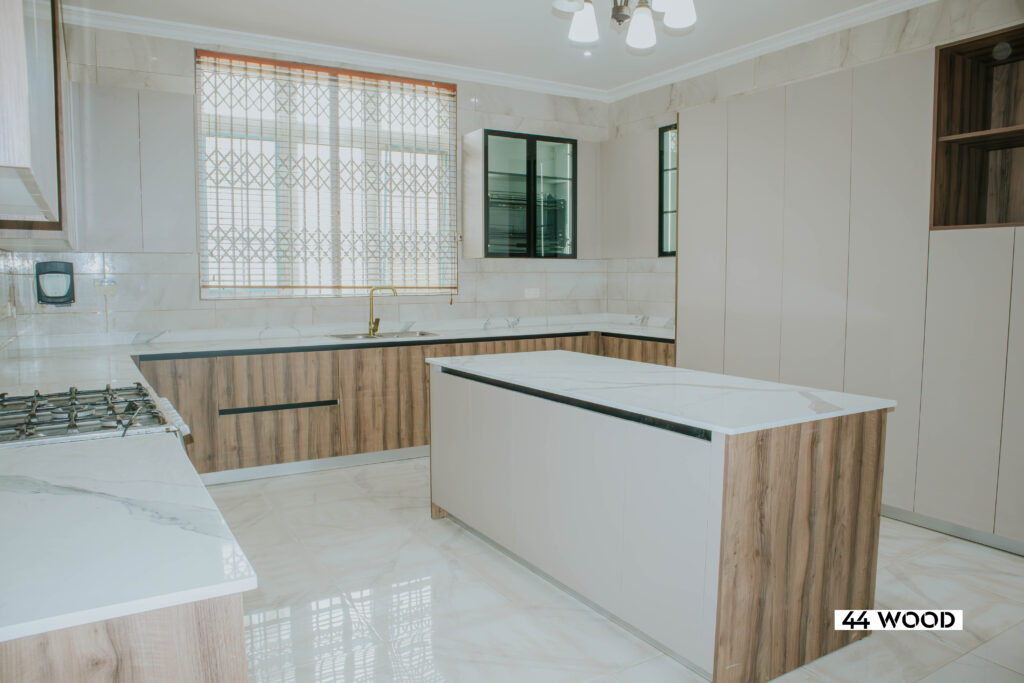
Warm wood grain finishes are having their strongest moment in years. Oak-effect and walnut-effect boards are being chosen consistently over all-white and all-grey directions in new builds across East Legon, Cantonments, and Airport Hills.
Bold colour in matte finish is the direction for homeowners who want a kitchen with a distinctive personality. Forest green, deep navy, sage, and warm charcoal are all being specified with confidence.
Integrated everything is the functional trend: appliances hidden behind matching cabinet panels, cables contained within the structure, a kitchen that reads as one continuous piece of kitchen furniture design rather than a collection of individual elements.
What new kitchens look like in 2026 can be summarised simply: cleaner, warmer, and more considered than at any point in the previous decade. The over-decorated kitchen of the 2000s and the sterile all-white kitchen of the 2010s have both given way to something more confident and more liveable.
What Type of Kitchen Cabinets Are Best?
There is no single answer, because the best cabinet type depends on the kitchen, the lifestyle, and the budget. But here is the honest breakdown:
Custom fitted kitchen cabinets are the best option for most Ghanaian homeowners building or renovating. They are designed and built to the exact dimensions of your kitchen, which means no wasted space, no gaps, and no workarounds. Every centimetre of wall is used. Every interior configuration is designed around what you actually cook with and store.
Ready-made kitchen cabinets are the best option if budget is the primary constraint, if you need a quick solution, or if the kitchen is a rental property where long-term investment is not the priority.
The distinction between custom and ready-made is not only about aesthetics. It is about function. A kitchen built to your space and your workflow simply works better than one assembled from standardised parts.
What Are the Three Types of Kitchen Cabinets?
The three fundamental categories found in any kitchen are:
Base cabinets sit on the floor and form the primary work surface of the kitchen when the countertop is installed on top. They house the heaviest items: pots, pans, and large appliances. They are typically 850mm tall (including countertop), 600mm deep, and vary in width.
Wall cabinets are mounted on the wall above the countertop, providing storage for lighter items: plates, glasses, dry goods, spices. They are typically 300 to 400mm deep and positioned 500 to 600mm above the countertop surface.
Tall cabinets run floor to ceiling and serve as pantry units, appliance housing, or larder storage. A tall cabinet housing a built-in oven at eye level is one of the most practical upgrades in any kitchen design.
Beyond these three structural types, modern kitchens also commonly include kitchen islands (freestanding or built-in central units), corner units (with carousel mechanisms to utilise corner space), and open shelving sections integrated with the cabinet run.
What Makes a Kitchen Look Cheap?
This question is asked more often than almost any other in kitchen design, and the answers are consistent across every market. Here is exactly what makes a kitchen look cheap, and what to avoid:
Visible gaps and poor fitting. When cabinets do not reach the ceiling, do not meet corners cleanly, or have inconsistent reveals between doors, the kitchen reads as assembled rather than designed. A properly fitted kitchen has no visible gaps.
Low quality door fronts. Thin door panels that flex when you press them, melamine surfaces that scratch easily, and edges that show the chipboard core underneath signal cheap materials immediately.
Poor hardware. Cabinet doors that do not close properly, drawers that stick or rattle, and hinges that allow doors to sag are all hardware failures. Soft-close mechanisms that actually work are one of the clearest signals of quality in any kitchen.
Cluttered countertops. A kitchen with inadequate storage puts everything on the counter. Good kitchen cabinet design puts everything away.
Mismatched elements. A premium cabinet finish paired with a cheap tile backsplash, or quality cabinets with a budget laminate countertop, creates a visual inconsistency that undermines the whole.
Exposed cables and appliances. Decoders, routers, extension boxes, and appliance cables sitting visible in the kitchen make even good cabinets look unfinished.
Outdated colours make a kitchen read as old regardless of the actual cabinet quality.
What Is the Best Colour for Kitchen Cabinets?
There is no single best colour, but there are colours that work consistently well across different kitchen sizes, light conditions, and interior styles:
White and off-white are the most universally successful kitchen colours. They reflect light, make spaces feel larger, work with any countertop or backsplash, and never feel dated. Off-white is more forgiving than pure white in a working kitchen, showing marks less readily while retaining the brightness of white.
Warm grey is the most sophisticated neutral. Cooler than cream, warmer than pure white, it adds depth without darkness and pairs beautifully with marble-effect countertops.
Warm wood grain is the most popular current direction for homeowners who want natural warmth in the kitchen. It works particularly well as a lower cabinet finish paired with a lighter upper.
Forest green and sage are the bold colours that have proven staying power. Unlike trend-specific colours that date quickly, green has a natural quality that anchors it to something more timeless.
Navy blue reads as sophisticated and considered, particularly in larger kitchens where the depth of the colour has room to breathe.
Colours that currently make a kitchen look expensive include warm off-white, sage green, warm grey, charcoal, and deep navy, all in matte finishes, paired with natural stone or stone-effect countertops.
What Cabinet Colour Is Outdated?
Some colours that were popular in previous decades are now reading as dated in the Ghanaian kitchen context:
High-gloss red and orange were fashionable in the 2000s and now feel strongly of that era. They are not timeless.
Honey-toned wood with black trim was popular in the 2010s and now feels heavier and more dated than contemporary wood grain choices.
Cream with ornate door profiles reads as an older kitchen style, particularly when combined with coving detail and traditional hardware.
Bright yellow and primary colours as full cabinet finishes have a short design lifespan.
What kitchen cabinet colours will look outdated in 2026 and beyond: over-saturated gloss finishes in non-neutral colours, heavily veined artificial wood patterns that do not look realistic, and any colour used with ornate, heavily profiled door fronts.
What Colours Make a Kitchen Look Expensive?
The colours and combinations that consistently make a kitchen read as premium and considered:
Sage green or forest green in matte finish with brass or gold hardware and natural stone countertops.
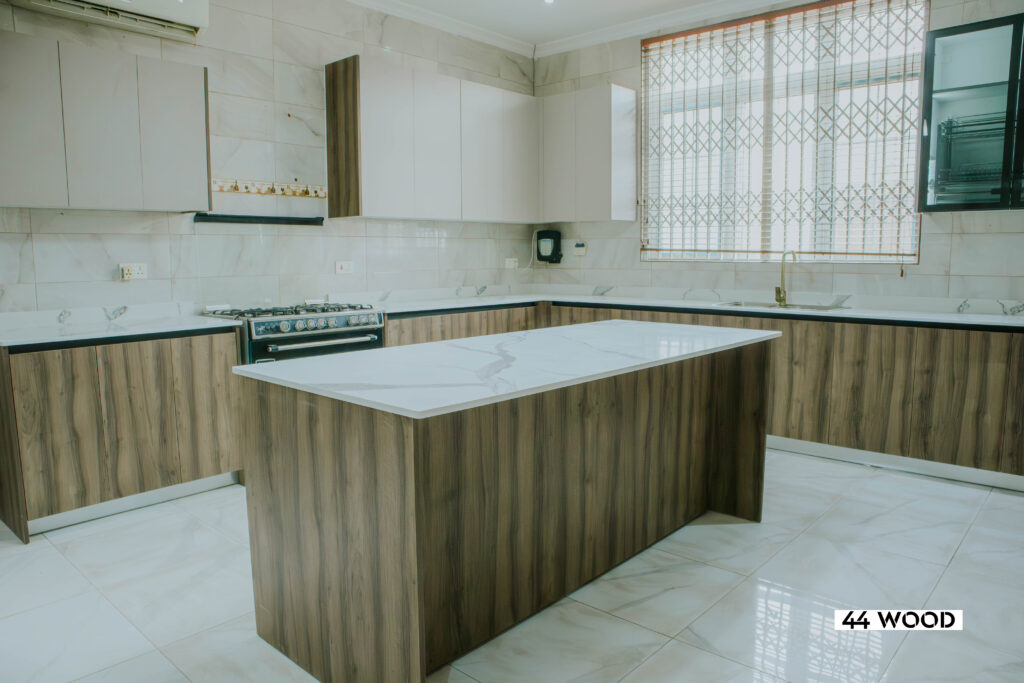
Warm off-white with integrated handles and marble-effect countertop. This combination photographs well and lives well.
Charcoal grey with light oak accents and white stone countertop. The contrast creates sophistication.
Deep navy with brushed brass hardware and white marble countertop. One of the most dramatic and expensive-looking kitchen directions available.
Natural wood grain on the full kitchen, lower and upper, with a clean stone countertop. When the wood tone is warm and the grain is realistic, this reads as genuinely luxurious.
What Colours Make a Kitchen Feel Bigger?
Light colours are the primary tool for making a kitchen feel more spacious:
White is the most effective colour for making a kitchen feel open. It reflects maximum light and removes visual boundaries.
Light grey achieves a similar effect with slightly more depth.
Pale sage or very light green adds a gentle warmth while keeping the space feeling airy.
Handleless cabinet fronts in any of these colours make the kitchen feel more spacious because there are no hardware elements breaking the visual line of the cabinet face.
Matching the countertop and backsplash closely to the cabinet colour removes the horizontal band of contrast that divides the kitchen visually, making the wall run read as one continuous surface.
For smaller Ghanaian kitchens, a light upper cabinet with a slightly deeper lower cabinet direction creates the illusion of a taller room while still providing colour interest.
What Colours Should You Avoid When Choosing Kitchen Cabinets?
For most kitchens, particularly in Ghana where cooking is intensive and kitchens take considerable daily wear, these are the colour directions that create the most practical and aesthetic problems:
Very dark, very small: Dark colours in compact kitchens without strong natural light make the space feel enclosed. If the kitchen is small, keep the base colour light and use darker accents.
Pure bright white in high-traffic kitchens: Stark white shows every mark and requires constant cleaning to look good. Off-white is almost always more liveable.
High-gloss in highly saturated colours (bright red, orange, yellow): These date quickly and are unforgiving of any surface imperfection.
Colours chosen independently of the countertop and floor: A cabinet colour that looked good on a sample card but clashes with the tile floor or backsplash already in the kitchen is a common and expensive mistake.
Should Kitchen Cabinets Be Lighter or Darker Than Walls?
The most successful kitchen designs in 2026 handle this relationship deliberately rather than accidentally.
Lighter cabinets against a slightly deeper wall creates a clean, considered look where the wall recedes and the cabinetry comes forward.
Darker base cabinets against a lighter wall and backsplash is the principle behind the two-tone kitchen: grounding the lower half of the room while keeping the upper half bright.
Matching cabinets closely to the wall creates a seamless, enveloping look that works well in large kitchens but can feel flat in smaller ones.
The rule worth following: the countertop should provide contrast with both the cabinet colour and the wall colour, anchoring the horizontal work surface and giving the eye a clear visual distinction between the storage zone and the working zone.
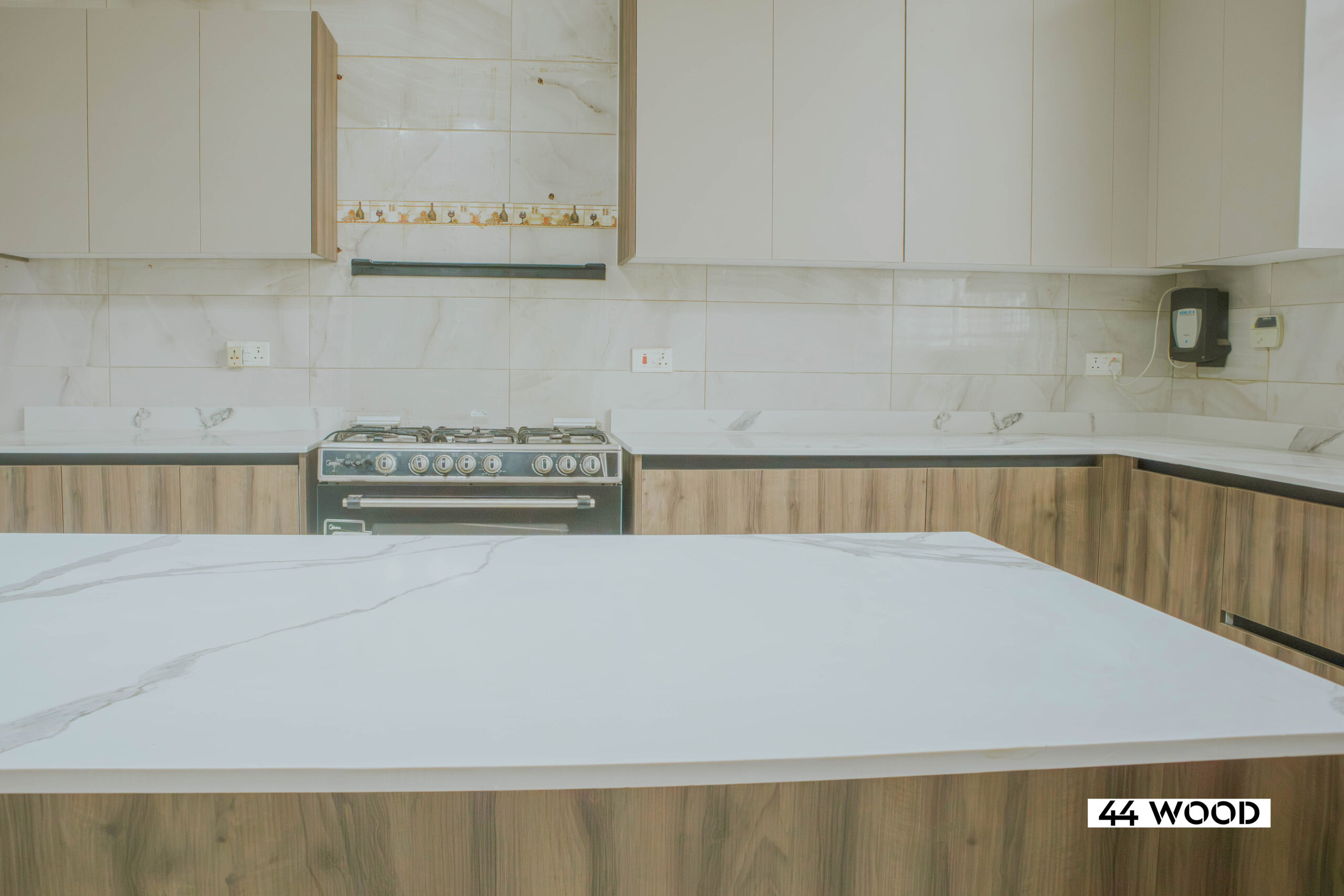
Is It Cheaper to Build or Buy Kitchen Cabinets?
In Ghana, buying ready-made is cheaper upfront. Building custom is cheaper over time, in most cases, and better in almost every other respect.
The relevant calculation is not what you pay today but what you pay across the usable life of the kitchen. A cheap ready-made kitchen that deteriorates in three to four years costs more over a decade than a properly built custom kitchen that lasts 15 to 20 years. Add the inconvenience and disruption of replacement, and the gap widens further.
The circumstances where buying ready-made makes more sense: rental properties, short-term occupancy, very tight budgets where a functional kitchen is the only realistic goal.
The circumstances where building custom is clearly better: any home you own and plan to live in for more than five years, any kitchen where fit matters, any kitchen where specific storage requirements are not met by standard sizes.
Is building custom cabinets hard? Building them yourself is a skilled trade requiring specialised equipment, precision measurement, and considerable experience. It is not a sensible DIY project unless you are a trained cabinet maker. Commissioning a professional custom furniture manufacturer to build them is not hard at all from the homeowner’s perspective. You brief, they design and build, they install.
How Long Do Custom Kitchen Cabinets Take?
The timeline from initial consultation to completed installation at 44 Wood typically breaks down as follows:
Design consultation and site measurement: One to two visits, completed within the first week.
Design drawing and client approval: Usually one to two weeks, depending on revision rounds.
Manufacturing: Four to six weeks from approved design. This is where the boards are cut, edges finished, doors produced, and hardware fitted.
Installation: Two to five days on site for most kitchen sizes. Larger kitchens with islands, integrated appliances, and countertop installation take closer to a full week.
Total timeline from first contact to finished kitchen: Typically six to ten weeks.
This is why planning ahead matters. A kitchen for a home being completed in December should be commissioned no later than October. Clients who contact us two weeks before they need the kitchen installed are almost always disappointed by the timeline.
The cheapest way to buy kitchen cabinets is not always the fastest way. Cheap kitchens assembled quickly from substandard materials rarely serve the kitchen well for long.
Is a Custom Kitchen Cabinet Worth It?
Yes. In the Ghanaian context particularly, custom kitchen cabinets are worth the investment for any homeowner who plans to live in their home for more than a few years.
Here is why:
Ghana’s climate is demanding. Heat, humidity, daily cooking with high-heat methods, steam, and moisture exposure mean that cabinet materials need to be specifically suited for the environment. Quality custom kitchen cabinets using premium European-grade board and proper edge sealing handle this. Cheap ready-made cabinets using low-grade particleboard with thin melamine surfaces do not.
Standard sizes do not fit most Ghanaian kitchens. The kitchen was not designed around a European cabinet module. Custom means built for the space as it is, not adjusted and compensated to fit a standard that was never intended for it.
Storage designed for how you cook is transformative. A Ghanaian kitchen that cooks seriously every day has different storage requirements from a generic European household. Custom design accounts for this.
The long-term value is clear. A kitchen that lasts 20 years is more cost-effective than two replacement kitchens across the same period, even when the upfront cost is higher.
What Type of Cabinets Last the Longest?
In Ghana’s climate, the cabinets that last longest are those built from premium moisture-resistant European-grade MFC (Melamine Faced Chipboard) for the carcasses, moisture-resistant MDF for painted door fronts, with full-bonded edge banding on all surfaces, and quality European hardware.
This combination outperforms solid wood kitchens in Ghana’s specific conditions, because solid wood expands and contracts with humidity changes, and in a kitchen that generates daily steam and heat, this movement causes problems over time without careful material selection and joinery design.
Which is better for cabinets, plywood or solid wood? In the Ghanaian kitchen context, neither outperforms premium MFC for cabinet carcasses when the MFC is of European grade with moisture-resistant core. Plywood is structurally strong but requires significantly more finishing work for kitchen use. Solid wood is beautiful but demands careful species selection and maintenance in a tropical climate.
The materials we use at 44 Wood are sourced from Italy and Turkey, where kitchen material engineering is at the highest standard globally. They are the same boards used in German and Italian kitchen brands that are considered benchmarks of quality.
What Makes Cabinets Look Expensive?
The elements that elevate kitchen cabinets from standard to clearly premium:
Consistent, precise fitting. No gaps. No misaligned doors. No visible inconsistencies. A kitchen that looks like it was designed for the room it is in.
Soft-close hardware that works silently. Every door and drawer closing gently and without sound is a quality signal that is felt physically, not just seen.
Quality surface finish. A matte finish that is truly flat, or a high-gloss finish that is truly smooth, with no visible texture inconsistency or surface marks.
Edge finishing. The edge banding on cabinet doors and carcass edges should be invisible. When done correctly, you cannot tell where the board ends and the banding begins. When done poorly, you can see it clearly.
Countertop quality. Natural granite or engineered stone with clean, precise edging elevates the whole kitchen. A premium cabinet paired with a thin laminate countertop looks unresolved.
Integrated lighting. LED strip lights under wall cabinets, lighting inside tall units, and ambient lighting that works with the cabinet design transform how a kitchen looks, particularly in the evening.
No visible cables or appliances breaking the line of the cabinet design.
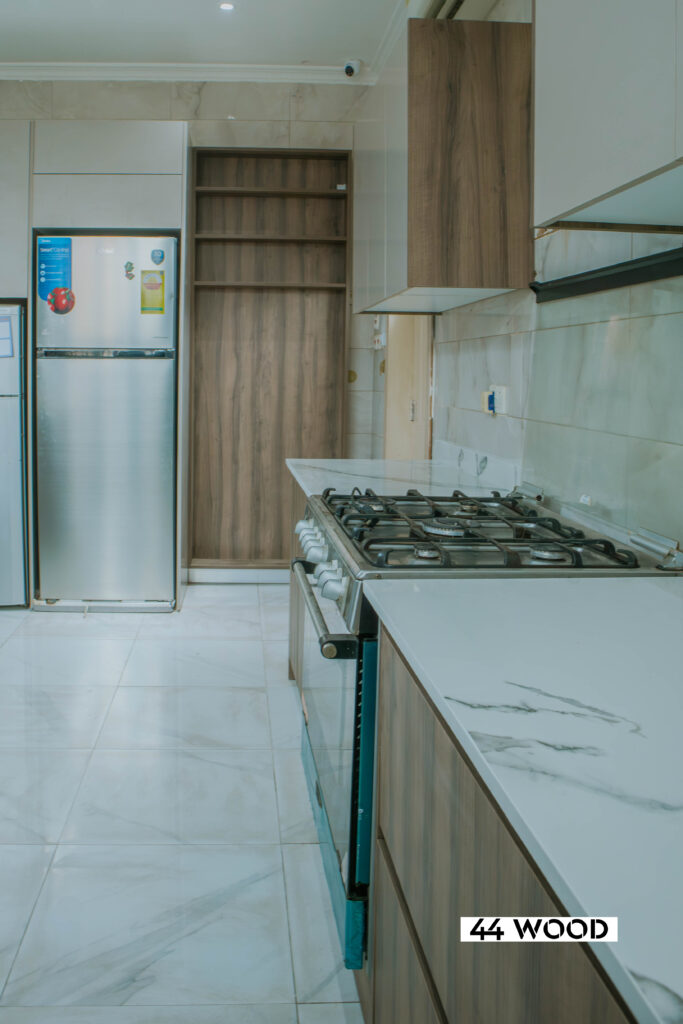
Should Kitchen Cabinets Go to the Ceiling?
In most cases, yes, and particularly in Ghana.
Floor-to-ceiling kitchen cabinets eliminate the gap above standard-height wall units where grease, dust, and cooking residue accumulate. In a kitchen that cooks seriously every day, that gap becomes a cleaning and hygiene problem. Reaching it is difficult; keeping it clean is harder.
Cabinets that go to the ceiling also provide significantly more storage, make the kitchen feel taller and more proportioned, and give the kitchen a more finished, designed appearance. A gap between wall cabinets and the ceiling is one of the details that most clearly reads as an incomplete or budget kitchen.
In new builds in Accra, particularly those with 2.7m or 3m ceiling heights, floor-to-ceiling kitchen cabinets are a standard expectation in well-finished homes.
The practical consideration is that the very top section of ceiling-height cabinets needs to be used for infrequently accessed items, since reaching it requires a step. But having that storage enclosed is better than leaving it as an inaccessible gap.
Signs That It Is Time to Replace Your Kitchen Cabinets
If your kitchen cabinets show any of the following, replacement is worth serious consideration:
Swelling at the base of cabinets, particularly near the sink, indicates moisture ingress into the board core. Once the board has swollen, it cannot be restored.
Door fronts that are delaminating, with the surface peeling away from the board underneath. This is a material failure that will progress.
Hinges that do not hold, causing doors to sag or not close properly, particularly if the hinge fixings have stripped out of the board. At a certain point, hardware replacement alone cannot fix this.
Drawer runners that stick, bind, or have failed, making drawers difficult to open and close. If the drawer sides have also swollen or warped, replacement is needed.
A pervasive smell in the cabinets that does not clear, indicating moisture damage or mould within the carcasse.
A kitchen that is simply too small or too poorly configured for how your household has grown. Functional inadequacy is as valid a reason to replace cabinets as physical deterioration.
Should I Paint My Kitchen Cabinets or Replace Them?
Painting kitchen cabinets is sometimes presented as a budget alternative to replacement. The honest answer is that it depends heavily on the condition of the cabinets.
When painting makes sense: The cabinet carcasses and structure are sound, the doors are flat MDF or solid wood in reasonable condition, the hinges and hardware still function well, and the only problem is the finish colour or a surface that looks tired. In this scenario, a professional respray can give the kitchen a significantly refreshed appearance at a fraction of replacement cost.
When replacement is the better choice: The board is damaged, swollen, or delaminating. The interior configurations do not serve the household well. The layout is wrong. The hardware is failing and replacement parts are not available for the existing system. The kitchen is simply too small.
Painting over poor-quality or damaged cabinets produces a poor result. Paint cannot fix board that has swollen or warped, and the effort and cost of preparation for a professional respray on cabinets in poor condition often approaches the cost of replacing the door fronts anyway
What Is the Most Expensive Part of a Kitchen Remodel?
Consistently, across all markets including Ghana, the most expensive element of a kitchen renovation is the cabinetry and fitting. It typically accounts for 40 to 50 percent of the total kitchen budget.
The next most significant costs are countertops (10 to 15 percent), appliances (15 to 25 percent), labour and installation (which in a custom kitchen build is typically included in the cabinet price), tiling and backsplash (5 to 10 percent), and plumbing and electrical work (5 to 10 percent).
The reason cabinetry dominates the budget is simple: it is the largest volume of material in the kitchen, it requires the most skilled labour to produce and install, and the quality of the materials used compounds directly in the final price.
What is a good budget for kitchen cabinets in Ghana? As a general guide, we recommend allocating a minimum of GHS 40,000 for a professionally manufactured and installed kitchen in a family home, with GHS 60,000 to GHS 100,000 being the range where a fully specified, well-executed kitchen with quality materials becomes consistently achievable.
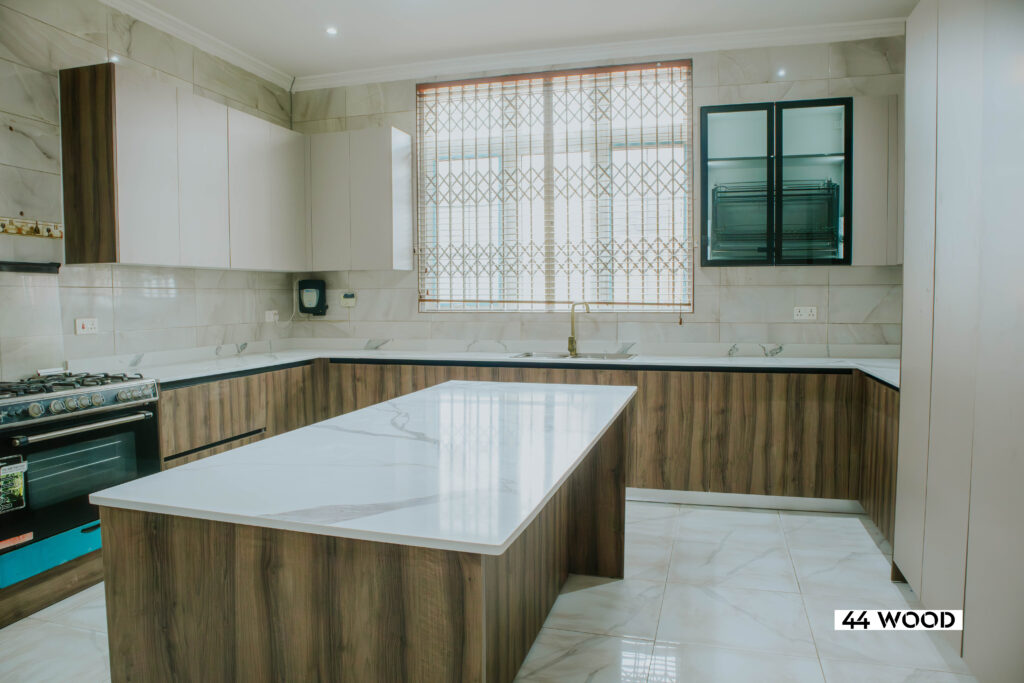
Who Makes the Best Custom Kitchen Cabinets in Ghana?
For custom kitchen cabinets in Ghana, the names that appear consistently in the conversations architects, interior designers, and experienced homeowners have are companies that have demonstrated the ability to design, manufacture, and install at a standard that lasts.
44 Wood is one of the most established kitchen cupboard manufacturers in Ghana. We design, manufacture, and install fully custom kitchens using premium materials sourced from Italy and Turkey. We have showrooms in Dzorwulu, Palace Mall, and Tema, and our portfolio includes completed kitchen installations across Accra, Tema, and major residential developments throughout Greater Accra.
What makes a kitchen furniture manufacturer worth choosing in Ghana comes down to four things: the grade of materials used, the precision of the manufacturing, the quality of the installation, and whether they stand behind the work with a genuine guarantee. At 44 Wood, all four are standard on every project.
What Are the Best Colours for a Kitchen?
Bringing together everything above, here is the clearest summary:
Never wrong: Off-white, warm grey, warm wood grain. These are the colours that work across the widest range of kitchen sizes, light conditions, and decorative styles, and that have the longest design lifespan.
Bold choices with staying power: Forest green, sage, deep navy, warm charcoal. These require confidence and the right kitchen context, but done well they produce kitchens that are memorable and distinctive.
Avoid in most Ghanaian kitchens: Very dark colours in compact spaces, pure bright white in high-cooking households, highly saturated gloss colours in non-neutral tones.
The combination principle: The best kitchen colour is rarely one colour alone. It is a combination of cabinet colour, countertop tone, backsplash, floor, and lighting that works together as a considered whole. This is why working with a designer rather than making these decisions independently produces better results
Ready to Design Your Kitchen?
If this guide has moved you from general curiosity to specific intent, the next step is a conversation with a kitchen designer who can look at your actual space and tell you what is specifically possible.
At 44 Wood, we are one of the leading kitchen furniture manufacturers in Ghana and among the most trusted furniture companies in Accra for kitchen cabinet design and installation. Our process starts with a site visit, proceeds through detailed design drawings, and ends with a fully installed and guaranteed kitchen.
let 44 Wood bring your vision to life with a custom space that fits your space, preference and your lifestyle. Discover more: https://www.44wood.com, Message 44 Wood on WhatsApp. https://wa.me/message/7HF3H2PGFS4GP1, Visit our showroom at Spintex, Accra or call 059 222 1787 to get started
The right kitchen does not just look good on the day it is installed. It works well every day for the next twenty years. That is the standard we build to.
44 Wood | Custom Kitchen Cabinets · Fitted Kitchens · Walk-In Closets · TV Units · Wardrobes · Cladding · Pharmacy Shelving One of the leading furniture stores in Ghana and furniture manufacturers in Accra – designing and installing bespoke interiors across Ghana for over a decade.