MFC vs. MDF vs. Solid Wood: The Best Material for Kitchen Cabinets
By 44 Wood | Custom Kitchen Cabinets & Furniture in Accra, Ghana
MFC vs. MDF vs. Solid Wood: Best Material For Kitchen
Here’s a question we get asked constantly at 44 Wood, sometimes by homeowners who are deep in the research phase, sometimes by people standing in our showroom comparing cabinet samples, and sometimes by clients who’ve already been given a quote by someone else and want to understand what they’re actually paying for:
“What material should my kitchen cabinets be made from?”
It’s the right question to ask. The material used in your kitchen cabinets determines how long they last, how well they handle Ghana’s heat and humidity, how the finished surface looks and holds up, and ultimately whether you’re getting real value for your money or paying for something that will let you down in three to five years.
The three materials that dominate the kitchen cabinet conversation in Ghana right now are MFC (Melamine Faced Chipboard), MDF (Medium Density Fibreboard), and solid wood. Each has a role. Each has trade-offs. And the right answer depends on what you’re building, where, and to what standard.
Let’s break them all down, plainly and honestly.
What Are These Materials, Actually?
Before we get into comparisons, you need to know what you’re dealing with.
MFC: Melamine Faced Chipboard
MFC is an engineered board made by compressing wood chips, sawdust, and resin under high pressure to form a rigid panel, then bonding a melamine resin surface to both faces. That surface is where the colour, texture, and finish come from and it can be printed to look like wood grain, solid colour, high gloss, matte, or almost any finish you can imagine.
When you see a kitchen cabinet that looks like it has a wood finish but isn’t actually made from timber, it’s almost certainly MFC. It’s the material used across the majority of modern kitchen installations globally, including by major European brands because when produced to a high standard, it performs extremely well and gives outstanding aesthetic results at a manageable cost.
MDF: Medium Density Fibreboard
MDF is made from even finer wood fibres than MFC, combined with resin and compressed under heat and pressure. The result is an extremely dense, smooth, and consistent panel with no grain. It has no knots, voids, or natural inconsistencies which makes it the material of choice for applications where an ultra-smooth surface and precise cutting are critical.
MDF can be painted to a high-gloss finish that is difficult to achieve with any other material. It machines cleanly, holds intricate routed profiles well, and takes paint and lacquer beautifully. For kitchen cabinet door fronts and painted furniture, it’s often the premium choice.
Solid Wood
Solid wood is exactly what it sounds like timber milled directly from trees. In Ghana, you’ll find solid wood kitchens made from locally sourced species like Wawa, Odum, Sapele, and Mahogany, as well as imported hardwoods like oak, ash, and walnut used in higher-end installations.
Solid wood is the most natural option and has a warmth and character that engineered boards cannot fully replicate. It can be refinished, sanded, and repaired in ways that MFC and MDF cannot. It also comes with the most significant trade-offs, particularly in Ghana’s climate.
How Do They Compare? The Full Breakdown
Durability and Structural Strength
MFC has excellent structural rigidity for cabinet carcasses, the boxes that form the body of your kitchen. High-density MFC (typically 18mm boards) handles the load of shelving, pots, pans, and heavy kitchen equipment very well. The edges need to be finished with edge banding to prevent moisture ingress, but when this is done properly, MFC cabinet carcasses are extremely robust.
MDF is dense and strong, but heavier than MFC, and its strength-to-weight ratio makes it less ideal as a structural carcass material. Where MDF truly excels is in door fronts and decorative panels, applications where surface quality matters more than structural load-bearing.
Solid wood is naturally strong and, in well-dried, properly jointed construction, is extremely durable structurally. The challenge is consistency; solid wood moves as humidity and temperature change, which means poorly dried or unseasoned timber can warp, crack, or develop gaps at joints over time.
Verdict for Ghana: High-quality MFC wins for cabinet carcasses. MDF wins for painted door fronts. Solid wood wins if budget allows and the timber is properly seasoned and treated.
Moisture and Heat Resistance: The Ghana Factor
This is where the conversation becomes specifically important for kitchen cabinets in Ghana. Our climate is not forgiving. Humidity is high. Temperatures are consistently warm. Kitchens generate steam, cooking moisture, and heat on a daily basis. The material in your wooden kitchen cabinets needs to handle all of this every single day, for years.
MFC from a quality manufacturer, particularly the European-grade boards we use at 44 Wood, sourced from Italy and Turkey has moisture-resistant core options and a melamine surface that is highly resistant to water, steam, and cleaning chemicals. Properly edged and sealed, quality MFC handles Ghanaian kitchen conditions exceptionally well. Budget MFC with thin, poorly adhered melamine and unfinished edges is a different story; it swells, delaminates, and deteriorates quickly.
MDF is more vulnerable to moisture than quality MFC. Standard MDF swells significantly when exposed to water and does not recover. Moisture-resistant MDF grades exist and perform considerably better, but MDF in general requires more care in a kitchen environment, particularly on lower cabinets near the sink and dishwasher where splash exposure is highest.
Solid wood expands and contracts with humidity changes. In a controlled, climate-stable environment this is manageable. In an Accra kitchen with fluctuating humidity, temperature spikes from cooking, and daily steam exposure, solid wood cabinets can develop gaps at joints, warping in door panels, and surface cracking if the timber wasn’t properly dried and the joinery wasn’t engineered to accommodate movement. Properly treated hardwood performs better than softwood, but it requires significantly more care and maintenance than engineered boards.
Verdict for Ghana: Quality MFC is the most practical choice for kitchen cabinet carcasses in Ghana’s climate. Moisture-resistant MDF works well for door fronts when properly finished and sealed. Solid wood requires careful selection and ongoing maintenance to perform well in a daily-use Ghanaian kitchen.
Surface Finish and Aesthetics
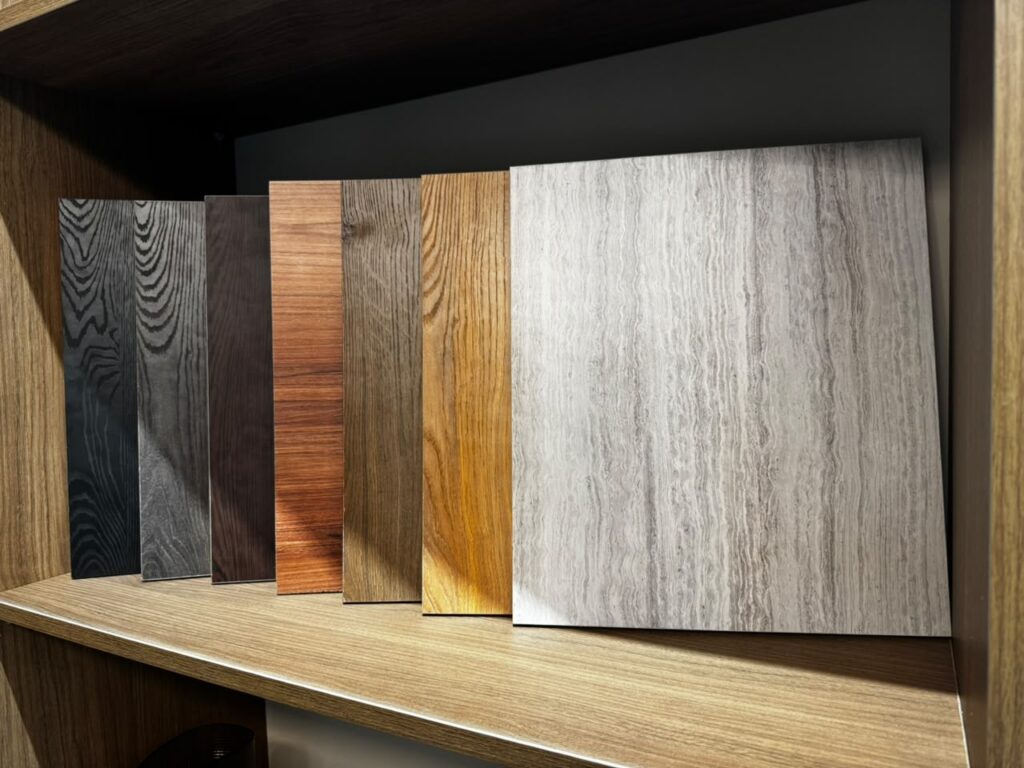
MFC offers an enormous range of finish options; wood grain textures, matte solids, gloss solids, stone effects, and more. The surface is applied at the factory under precision conditions, meaning the finish is consistent across every panel. There are no visible brush marks, grain variations, or colour inconsistencies. Modern high-resolution printing technology means quality MFC wood grain finishes look genuinely compelling not like an imitation.
MDF takes paint to a near-perfect surface. A well-prepared and lacquered MDF door front has an almost mirror-smooth finish in high gloss that is simply not achievable on MFC or solid wood. If you want a painted kitchen particularly in high gloss or satin, MDF door fronts are the premium choice for finish quality.
Solid wood has natural beauty that engineered materials cannot fully replicate the grain depth, warmth, and character are real and distinctive. However, it is also less predictable: grain patterns vary, colour can be inconsistent across different pieces, and achieving a fully uniform look requires significant finishing work. For a natural, oiled or stained wood look, solid wood is genuinely beautiful. For a uniform, colour-consistent modern kitchen, engineered boards are more reliable.
Verdict: MFC for versatility and wood-effect finishes. MDF for painted doors and ultra-smooth surfaces. Solid wood for natural timber character and traditional warmth.
Workability and Machining
MFC cuts cleanly with the right tooling and holds screws and fixings well when the correct hardware is used. Edge banding is required on all cut edges to seal and finish them. It does not route as cleanly as MDF for decorative profiles.
MDF is the most machining-friendly of the three. It cuts with exceptional precision, routes cleanly for decorative profiles and edge details, and holds its shape perfectly after cutting. This is why MDF is preferred for kitchen doors with routed panel designs, decorative mouldings, or curved profiles.
Solid wood machines well but requires significantly more skill and time. Grain direction affects how the material cuts and routes. Knots and grain variations can cause inconsistency. Hand skills and experienced joinery are essential to work solid wood to a high cabinet-making standard.
Verdict: MDF wins for precision and decorative work. MFC for straightforward carcass construction. Solid wood requires skilled hands to achieve consistent results.
Cost
This is where the decisions often get made in Ghana and where the most important clarification needs to be made.
Budget MFC is cheap. It’s what you find in cheap kitchen installations, self-assembly furniture, and low-cost cabinetry. Thin melamine that peels, boards that swell, edge banding that lifts, hinges that strip out. This is not the MFC used in quality European kitchens.
Premium MFC high-density board, quality melamine surface, proper edge banding, and precision-cut to spec is the material used by serious kitchen manufacturers globally. It is mid-range in cost, not the cheapest option, but significantly more affordable than solid wood for the same cabinet volume.
MDF sits at a similar or slightly higher price point than premium MFC, depending on grade and thickness. Moisture-resistant MDF is more expensive than standard.
Solid wood is the most expensive option, sometimes two to three times the cost of an equivalent MFC kitchen. When locally sourced Ghanaian hardwoods are used, the cost premium is lower; imported European hardwoods like oak or walnut push costs considerably higher.
Verdict: Premium MFC offers the best value for money in a well-designed kitchen. MDF adds cost but justifies it for painted door applications. Solid wood is a premium investment that makes sense in certain applications and budgets.
Longevity: What Actually Lasts in a Ghanaian Kitchen?
The honest answer is this: the material matters less than the quality of that material and the quality of the installation.
A cheap solid wood kitchen installed by unskilled carpenters using unseasoned timber will fail faster than a well-built kitchen using premium MFC with quality hardware, proper edge finishing, and correct installation. We see this regularly in Ghana where clients who come to us after a “wooden kitchen” installed by a local carpenter has swollen, cracked, or fallen apart within two or three years.
The questions you should actually be asking any kitchen supplier in Ghana are:
- What density and grade is the MFC board being used?
- Is the edge banding fully bonded and sealed, including internal edges inside cabinets?
- What brand and origin are the hinges, drawer slides, and hardware?
- For solid wood, what species is it, and how was it dried and treated?
- Is moisture-resistant board being used in zones near the sink and cooker?
These questions separate serious kitchen furniture manufacturers from people assembling cheap materials and charging a reasonable price.
What Does 44 Wood Use and Why?
At 44 Wood, we use premium European-grade MFC (sourced from Italy and Turkey) as our primary cabinet carcass material, and we specify moisture-resistant MDF for painted door fronts where clients choose that finish direction.
Here’s our reasoning:
The MFC boards we use are high-density (conforming to European E1 emission standards), with a factory-applied melamine surface that is significantly more durable than locally available board. The edge banding we apply is heat-bonded and fully sealed on all exposed and internal edges this is the detail that most determines whether an MFC kitchen survives Ghana’s humidity long-term.
Our hardware hinges, drawer runners, pull-out systems is sourced from the same supply chains as European kitchen brands. Soft-close mechanisms, push-to-open systems, and heavy-duty drawer slides are not an upgrade option; they are our standard specification.
For clients who specifically want solid wood elements a solid wood island top, solid timber open shelving, or a real wood inset panel as a feature and we incorporate these selectively where they add real value and where the application suits the material’s properties.
The result is a custom kitchen that performs like a European installation, is designed specifically for the Ghanaian climate, and is built to last and not to impress briefly and deteriorate quickly.
The Bottom Line: Which Material Should You Choose?
Here’s the straightforward answer for different situations:
Building a new kitchen and want the best value, durability, and finish range? → Premium MFC carcasses with MDF painted door fronts (or MFC wood-grain doors if you prefer a natural look). This is what most serious kitchen manufacturers use globally, and for good reason.
Want a painted kitchen with an ultra-smooth, high-gloss or satin finish? → MDF door fronts on MFC carcasses. The combination gives you the best of both materials.
Want natural wood character and warmth, and have the budget? → Solid hardwood but specify the species carefully, ensure it is properly dried, and understand it requires maintenance. Works best in kitchens where cooking is moderate rather than intense and daily.
Working with a tight budget and comparing options? → Do not compromise on board grade and hardware. A smaller, well-built kitchen in premium MFC will serve you far better than a larger kitchen in cheap board. Budget for quality where it counts.
Concerned specifically about humidity and heat near the sink or cooker? → Insist on moisture-resistant board grades in those zones regardless of which material direction you go. This is non-negotiable for a kitchen in Ghana’s climate.
Working With a Supplier: What to Look For
Whether you’re working with 44 Wood or any other kitchen cupboard manufacturer or furniture company in Ghana, the material conversation should be transparent. Any serious kitchen furniture supplier should be able to tell you:
- The exact board specification (density, grade, moisture resistance rating)
- The origin and brand of the melamine surface and edge banding
- The hardware brand and load rating for hinges and drawer systems
- Whether installation includes proper sealing of all edges
If a supplier can’t answer these questions specifically or deflects with vague assurances about “quality materials” without specifics, that’s a signal worth heeding.
At 44 Wood, we walk every client through these decisions during the design consultation. You will know exactly what is going into your kitchen and why, before a single board is cut.
Ready to Design Your Kitchen?
If you’re planning a new kitchen build or renovation and want to understand your material options in the context of your specific space, lifestyle, and budget, we’d love to sit down with you.
At 44 Wood, every project starts with proper site measurements, thoughtful design, quality craftsmanship, and professional installation ensuring your cabinetry is built specifically for your home.
If you’re ready to experience modern furniture design, crafted with precision, style, and collaboration at its core, 44 Wood is ready to design with you, for you. Why settle for generic when your bedroom can reflect your style, personality, and space perfectly? If you’re dreaming of a kitchen space that’s functional, elegant, and uniquely yours, it’s time to talk to 44 Wood.
let 44 Wood bring your vision to life with a custom space that fits your space, preference and your lifestyle. Discover more: https://44wood.com, Message 44 Wood on WhatsApp. https://wa.me/message/7HF3H2PGFS4GP1, Visit our showroom in Dzorwulu, Accra or call 0592221787 to get started
44 Wood | Custom Kitchens · Walk-In Closets · TV Units · Wardrobes · Cladding – One of the top furniture shops in Ghana – proudly serving Accra and beyond for over a decade.